Who made it?
We examine production techniques and traces of skill and learning. Comparing bead shapes and sizes helps us ask how standardised production was.
TÜBİTAK 2218 · Bilkent University
Body Adornment Technologies, Craft Specialisation, and Social Identities in Anatolian Prehistory
How did people in Anatolia make and wear beads, pendants and bracelets thousands of years ago? PRE-CRAFTS studies the traces on these small objects to explore how craft skills were learned and how ornaments shaped people’s sense of belonging.
Explore the research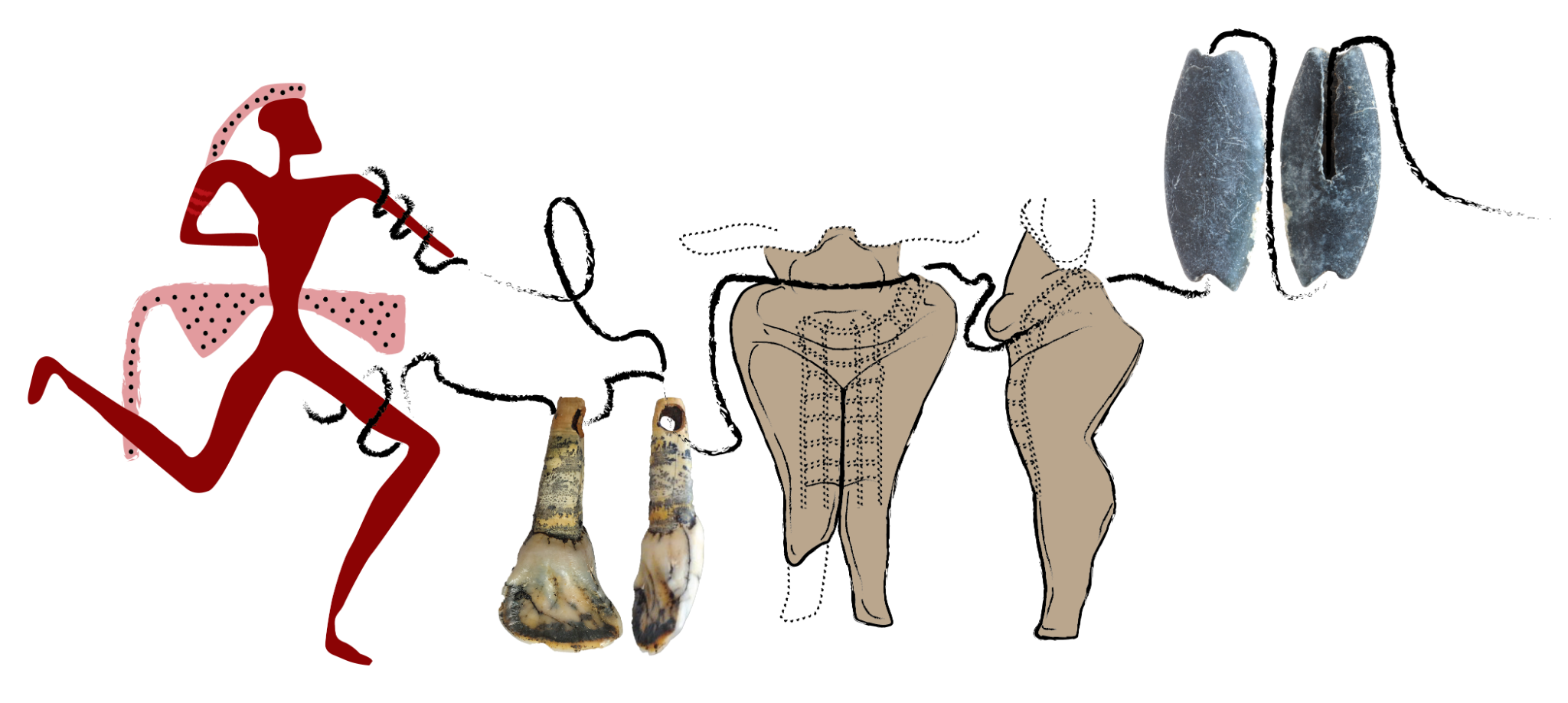
Scratches inside a hole can reveal how a bead was drilled. Wear along its edge can offer clues to how it was worn. The project reads these traces alongside the object’s shape, material and archaeological context.
We examine production techniques and traces of skill and learning. Comparing bead shapes and sizes helps us ask how standardised production was.
We study how ornaments were used, repaired and reused. In burials, we also examine how they are distributed by age and sex.
We bring evidence of production and use together to explore how people shared skills, took on roles within communities and expressed belonging through adornment.
We make replica beads using techniques such as abrasion, drilling and polishing, then compare the traces each process leaves on the surface.
We use morphometric measurements to compare the shapes and sizes of ornaments and assess variation and standardisation in production.
We examine traces of manufacture and use under the microscope. Confocal microscopy allows us to measure surface textures in three dimensions.
We use multivariate statistics to explore patterns across measurements, production techniques and traces of use.
The study covers ornaments made from stone, animal bone and teeth, and marine and freshwater shells from six Late Epipalaeolithic and Neolithic sites.
As the project progresses, we plan to share the experimental reference catalogue, datasets and protocols for experiments, sampling and quantitative trace analysis through Zenodo.